

Kaspersky discovered a new crimeware m campaign of targeting WhatsApp Desktop and WhatsApp Web users by distributing malicious VBScript files via direct messages on the platform. Victims have been identified across multiple countries and territories, including Malaysia, Brazil, Singapore, Taiwan and Vietnam, with the highest number of observed victims located in Malaysia. The use of multiple languages in file names also points to broad regional targeting, especially across Europe.
Kaspersky Global Research and Analysis Team Reveals WhatsApp Spreading Malware
The campaign was revealed in June 2026 by Kaspersky Global Research and Analysis Team (GReAT).
According to their research, the crimeware actor uses WhatsApp accounts that have been previously
compromised to distribute malicious attachments. The messages are sent from those accounts’ existing contacts, which increases the likelihood that recipients will view the files. Once installed, the
malware enables remote access to the system through standard administrative capabilities intended
for legitimate IT support and management use.
The social engineering component relies on file names designed to resemble routine business
documents. Observed examples include invoices, bank statements, account statements, payment
records, and debt notices. File names are also localized into multiple languages, including English,
Portuguese, French, German, and Malay, indicating distribution across different language regions. In
addition, the VBScript samples contain extensive comments and metadata intended to mimic
legitimate Microsoft Windows Update components.
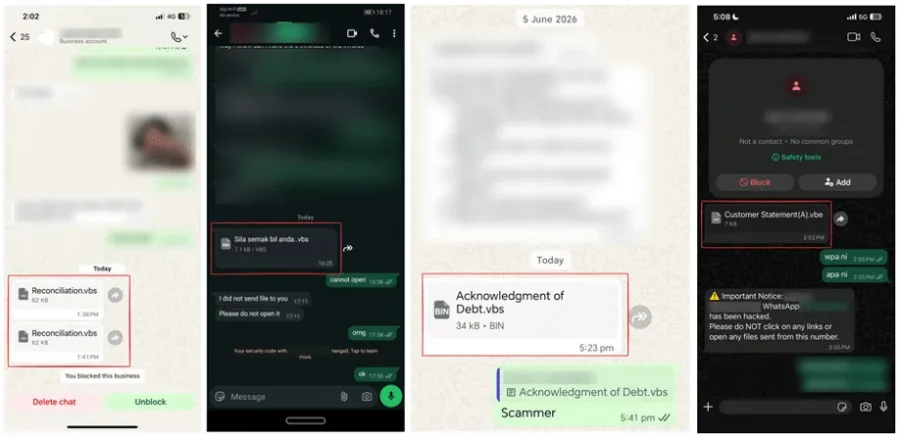
Examples of WhatsApp messages containing the malicious VBScript file. Source: alleged victim posts on social media
“In this campaign, attackers are exploiting trust within messaging platforms by using compromised
WhatsApp accounts to deliver malicious attachments that appear to originate from known contacts,
making recipients far more inclined to engage with them. The file names are carefully disguised as
routine business documents, such as invoices and payment notices, and localized across multiple
languages to support broad targeting. Once opened, they trigger a staged infection chain that silently retrieves and executes additional malicious components from external infrastructure,” says Fareed Radzi, security researcher at Kaspersky GReAT.
The execution flow of the attachment follows a multi-stage process on the affected system. Once
opened, the file triggers a scripted sequence on the device. The initial script creates a working directory under C:UsersPublicDocuments, then retrieves additional script files from external infrastructure and executes them using Windows Script Host. These follow-up scripts perform
additional system actions and download a compressed archive from the same infrastructure. The
archive contains an installation package for remote monitoring and management software.
Kaspersky GReAT experts recommend users to:
● Be cautious when receiving unexpected attachments through WhatsApp, even when they
appear to originate from known contacts, as they may be able to execute malware.
● Do not open script and executable file types such as .vbs, .vbe, .exe, .bat, .cmd, .js, and .ps1
unless their legitimacy has been independently verified.
● Use a strong security solution on all computers and mobile devices, such as Kaspersky
Premium. It will warn you and prevent any infection.