
Since last year, we’ve been testing different drones from DJI. Starting from their budget-friendly DJI Neo, moving to the entry-level DJI Flip, and even the more advanced DJI Air 3S. This time, I finally had the chance to review a flagship drone from DJI: the DJI Mavic 4 Pro. To maximize the experience, I shared this opportunity with my photography friends from Tarlac so we could really put the drone to the test.
Table of Contents
What’s Included?

When you open the box of the Fly More Combo, you are greeted by a premium shoulder bag that holds all the equipment. The bag itself is well-made, sturdy, and water-repellent, though I wouldn’t recommend relying on it during heavy rain since the flap corners remain slightly exposed. Still, for travel, the bag is very convenient. It has organizer compartments for the drone, charger, and controller, making it easy to pack and carry.

Inside the Fly More Combo, you’ll find the DJI Mavic 4 Pro Fly More Combo and contains the shoulder bag, DJI Mavic 4 Pro itself, DJI RC 2, x3 Battery, x4 Spare Propellers by Pairs, x2 USB-C to USB-C Data Cable, DJI 100W USB-C Power Adapter. and the DJI Mavic 4 Pro Parallel Charging Hub.
The Drone

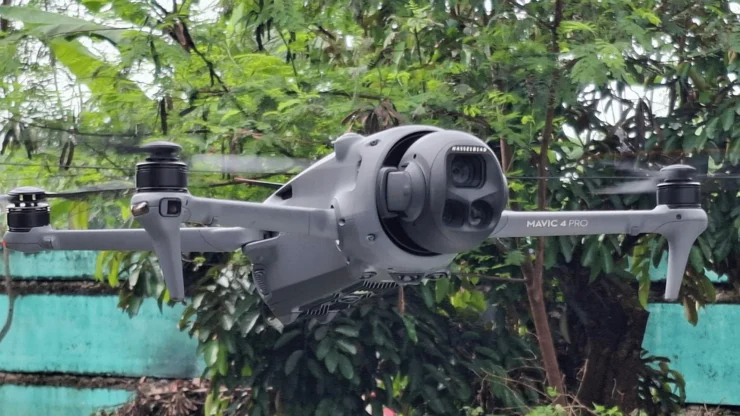
The DJI Mavic 4 Pro feels solid and well-built. It’s larger than the Air series, but its foldable arms still make it portable enough to carry around, especially since the Fly More Combo includes the travel bag.
Safety and stability are standout features. The drone is equipped with omnidirectional obstacle sensing powered by six high-performance fisheye sensors and dual processors for high-resolution environmental awareness. Even in extremely dark conditions below 0.1 lux, it uses a forward-facing LiDAR sensor to detect obstacles and automatically brake, giving pilots confidence when flying close to trees, buildings, or at night.
The Mavic 4 Pro also debuts DJI’s new O4+ transmission system, which improves range and reliability. It supports up to 30 km of range in ideal conditions. It is an upgrade from the 20 km limit on O4. The video feed remains smooth even in interference-heavy areas, and the drone’s wind resistance keeps footage stable in tougher conditions.
The Controller

The included DJI RC 2 controller looks similar to the previous DJI RC, but it has notable refinements that make it feel more professional. Its 5.5-inch FHD touchscreen can reach up to 700 nits of brightness, ensuring clear visibility even under direct sunlight. The Android-based interface is straightforward and user-friendly, letting you get airborne in no time.
At 420g, the RC 2 is lightweight despite having extra antennas and a built-in cooling system. The ergonomic design, textured grips, and responsive controls make it very comfortable to use. The controller also has 32GB of internal storage, with microSD expansion available for screen recordings, cached maps, and flight data. Its 22.3Wh battery provides up to three hours of use on a single charge, enough for multiple flight sessions.
The Camera

The camera system is where the DJI Mavic 4 Pro truly shines. It features a triple-camera array designed for versatile shooting.
DJI Mavic 4 Pro – Camera Sample//s.imgur.com/min/embed.js
The main wide-angle Hasselblad camera houses a 100MP 4/3” CMOS sensor with an adjustable aperture from f/2.0 to f/11. It captures incredibly detailed stills and supports video recording up to 6K@60fps. The large sensor gives it excellent dynamic range and low-light capability, producing natural colors with Hasselblad’s signature processing.
The medium telephoto camera features a 48MP 1/1.3” sensor, which is ideal for portrait shots and mid-range zoom. It delivers sharp, detailed 4K@60fps. For longer reach, the telephoto camera uses a 50MP 1/1.5” sensor, providing crisp long-distance video in 4K.
All three cameras share 10-bit video recording, supporting D-Log, D-Log M, and HLG profiles for professional color grading. They also benefit from HDR video support, Dual Native ISO Fusion, and RAW frame stacking, which significantly improve dynamic range and low-light performance.
DJI also introduced the Infinity Gimbal, allowing full 360° rotation and up to 70° upward tilt. This unlocks more creative flight angles and gives filmmakers more freedom in their shots.
In real use, the video quality is stunning. The wide dynamic range and clean low-light performance make footage look cinematic, while consistency across all three lenses ensures smooth transitions when switching perspectives mid-flight.
The Battery
Powering the drone is a 6,654mAh Intelligent Flight Battery that delivers up to 51 minutes of flight time. This endurance is among the best in the market and provides ample time for capturing complex shots.
Charging directly through the drone is possible but limited to 65W, taking around two hours for a full charge. The Fly More Combo includes the parallel charging hub and 100W USB-C adapter, which can recharge one battery in about 80 minutes. For even faster turnaround, DJI’s 240W adapter charges three batteries in roughly 90 minutes.
DJI Mavic 4 Pro Verdict

The DJI Mavic 4 Pro Fly More Combo is the most complete drone package I’ve tested so far. It combines premium build quality, extended flight time, reliable safety systems, and a world-class triple-camera setup. The main Hasselblad sensor produces professional-grade results, while the telephoto lenses add creative flexibility without compromising image quality.
While its size and premium price may not suit casual users, professionals and serious creators will find the DJI Mavic 4 Pro Fly More Combo a reliable investment that delivers outstanding footage and flight performance in nearly any scenario.