

Two new GSMA reports launched today at the Digital Trust Summit at M360 ASEAN warn that online scams, fraud and digital deception are increasingly challenging that trust and could undermine progress towards broader digital ambitions.
Table of Contents
Nearly Half of Reported Scam Cases in ASEAN Remain Unresolved
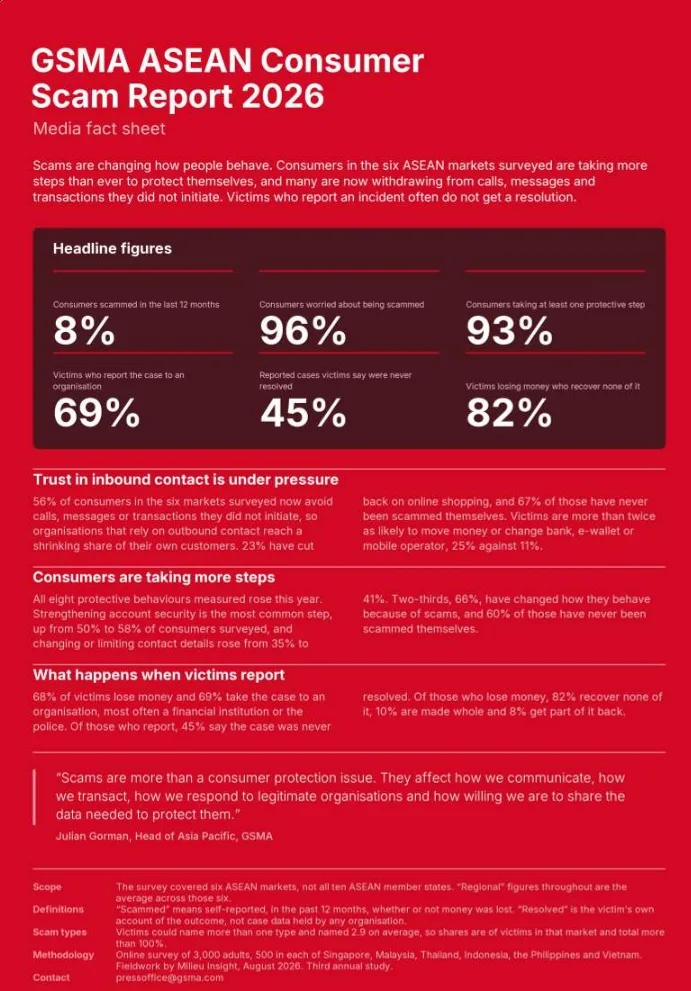
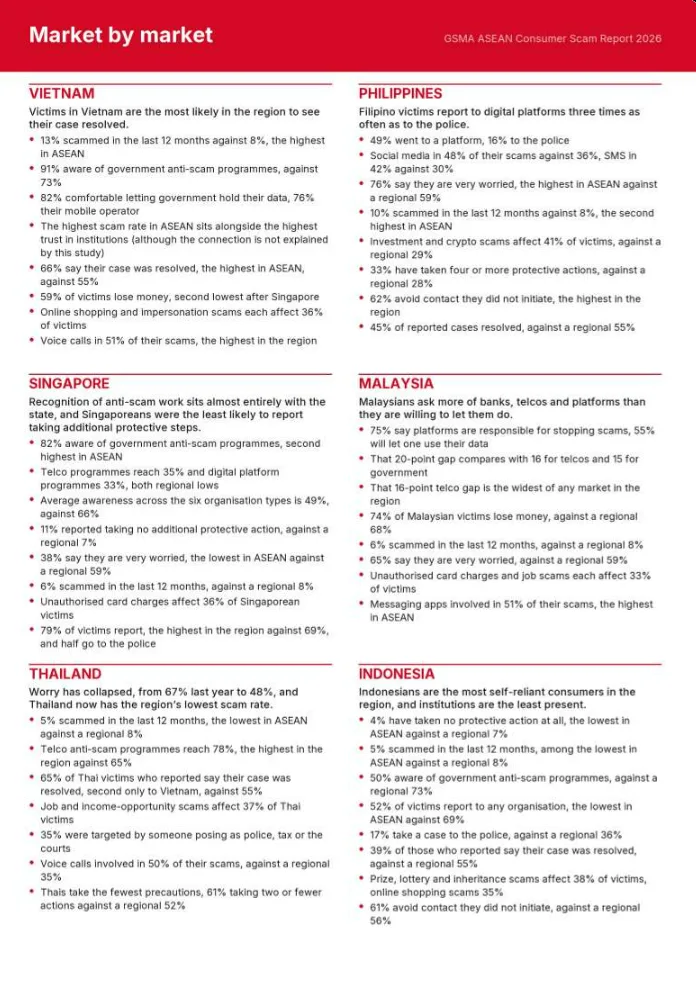
The first GSMA report, the GSMA ASEAN Consumer Scam Report 2026 , found that nearly half (45%) of reported scam cases across Indonesia, Malaysia, the Philippines, Singapore, Thailand and Vietnam remain unresolved despite consumers taking more steps to protect themselves. Consumers with unresolved cases report lower levels of trust in communications channels, digital platforms and data sharing, while many have changed how they engage with digital services and inbound communications.
The GSMA report also found that nearly one in ten (8%) consumers surveyed reported being scammed in the previous 12 months. Among scam victims, 68% lost money and, of those, 82% recovered none of their losses. Only 10% recovered all losses. Consumers who have experienced scams are more than twice as likely to switch accounts or service providers than those who have not been affected.
The second GSMA report, Digital Nations 2026: Building Trusted Digital Ecosystems in ASEAN , argues that trust has become a strategic enabler of ASEAN’s digital future. As countries across the region advance digital economy strategies, AI adoption, digital government programs and cross-border digital integration, the report highlights that confidence in digital infrastructure, services and institutions increasingly determines whether digitalization translates into adoption, innovation, investment and socioeconomic impact.
The report notes that emerging technologies are transforming the nature of digital trust itself. AI is enabling increasingly sophisticated phishing attacks, deepfakes, voice cloning and digital impersonation, making it harder for individuals and organisations to distinguish legitimate interactions from fraudulent ones. As a result, digital trust increasingly depends on the ability of the ecosystem to verify identities, authenticate communications, strengthen resilience and share trusted intelligence to prevent harm before it occurs.
Speaking during the Digital Trust Summit at M360 ASEAN, Julian Gorman, Head of Asia Pacific at the GSMA, said: “Access alone is no longer enough. As ASEAN’s digital economies become more sophisticated, people must have confidence that digital services are secure, reliable and accountable. The findings from these reports show that digital trust is increasingly becoming a prerequisite for digital participation, innovation and growth.
Building Digital Trust Across ASEAN
Countries that build confidence in digital infrastructure, services and institutions will be better placed to realise their digital ambitions. This will require governments, mobile operators, digital platforms, financial institutions and other stakeholders to work together to verify identities, authenticate communications and prevent fraud before harm occurs.”
Key findings from the GSMA ASEAN Consumer Scam Report 2026
• 96% of consumers worry about being scammed or hacked
• Nearly 9 in 10 consumers recognised at least one form of AI being used in scams.
• While 69% of victims reported scams, nearly half (45%) of reported cases remain unresolved
• Messaging apps are now the most common channel through which consumers encounter scams, accounting for 41% of scam experiences
• Consumer association of major digital platforms with scams has increased across the region
• Scam activity is increasingly shifting towards investment, cryptocurrency, online shopping and job scams where consumers are persuaded to send money themselves.
Mobile Operators Helping Build Trusted Digital Ecosystems
The Digital Nations 2026 report identifies four interconnected foundations of digital trust:
• Identity: the ability to verify people and organisations in digital environments.
• Communications: confidence in the authenticity and integrity of digital interactions.
• Resilient Networks: the infrastructure and cybersecurity capabilities that keep digital services available and secure.
• Collective Intelligence: the creation, sharing and use of trusted information to strengthen the security, resilience and integrity of digital systems.
The GSMA report argues that strengthening these foundations requires coordination across governments, regulators, mobile operators, financial institutions, digital platforms and other ecosystem participants. While traditionally viewed as connectivity providers, mobile operators increasingly contribute to all four trust foundations through identity verification, network security, fraud prevention, authentication services and trusted intelligence-sharing initiatives. Across ASEAN, operators are helping governments, businesses and citizens participate more safely and confidently in the digital economy.
Importantly, deeper regional collaboration can amplify the impact of national initiatives, helping countries learn from one another, strengthen resilience and build greater confidence in ASEAN’s digital transformation.
M360 ASEAN Digital Trust Summit in Kuala Lumpur
The Digital Trust Summit at M360 ASEAN brought together leaders from government, industry and international organisations to explore how ASEAN can strengthen trust in digital interactions and build more secure, resilient and inclusive digital ecosystems. Delegates heard from speakers representing Mobile Network Operators, Google, Meta, the International Telecommunication Union (ITU), Mastercard and governments from across the region.